Lim Li Ching & Goh Chien Yen, Third World Network
The Joint Submission on behalf of Australia, Canada, Japan, New Zealand, Norway, Switzerland and the United Kingdom proposes that Parties classified as “high-income” under the World Bank (WB) country income classification should be used to review and amend the list of Developed Country Parties and Other Parties that Voluntarily Assume the Obligations of Developed Country Parties, with the exclusion of Small Island Developing States.
In the first place, the provision in Article 20(2) clearly states that the process is voluntary. There should not be an automatic trigger based on “graduation” to the high-income category. Especially one that could redefine legal obligations under the Convention. Using the WB classification would be erroneous and illogical.
The classificatory bands of low, lower-middle, upper-middle and high-income countries are for the Bank’s
administrative purposes of allocating funds and the provision of technical assistance and advisory services. This should not be confused with the complex question of whether a country is, or is not, a developing country. Nor should an administrative measure be turned into a threshold to make this determination.
Further, the GNI per capita measure alone says little about the resilience of a developing country’s economy. It may have unequal distribution of income due to structural adjustment and international economic rules, or it might be heavily dependent on one or two sectors, or worse, one or two export commodities. As such, its economy might be fragile and vulnerable to pandemic, energy, climate, regulatory and policy shocks.
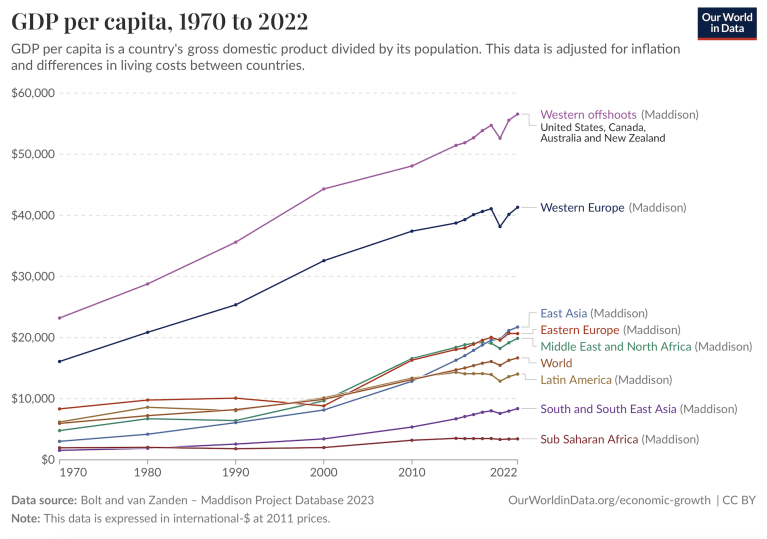
There is a discernible and growing gulf between groups of countries and that gap is not closing (see Figure 1). These countries can be bifurcated broadly as between developed and developing countries. Just as the USA’s astronomical GDP per capita, apex currency and cutting-edge technology does not make Western Europe “developing”, nor should the improved economic performance of a small handful of developing countries suddenly make them “developed”.
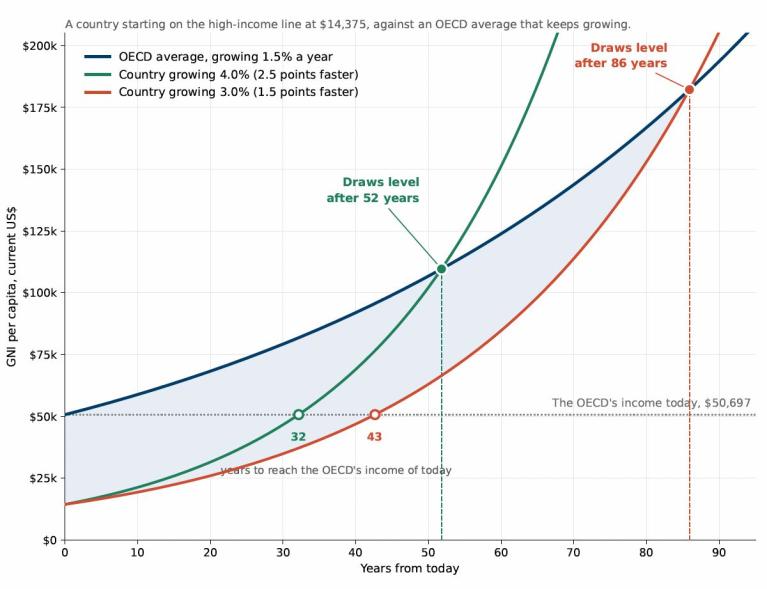
The World Bank high-income threshold is $14,375 for FY 2027. Most developing country economies above this threshold earn under half the OECD average ($50,697). And catching up would take generations (see Figure 2). An economy at the high-income threshold growing 1.5 percentage points a year faster than the OECD needs roughly 86 years to reach today's OECD average. At 2.5 percentage points higher, historically rare and rarely sustained, it needs 52 years. If crossing the high-income threshold signalled arrival as a ‘developed country’, the true arrival would still take two to three generations.