
Nele Mariën, Friends of the Earth International
After more than 30 years of CBD implementation, after the failure of the first strategic plan, and halfway through the implementation of the GBF, a painful reality needs to be acknowledged: biodiversity keeps declining at alarming rates, and our collective efforts have not reversed this trend.
As reporting and review begin, Parties will highlight their initiatives and intentions. Many will rightly point to resource and capacity constraints. Once again, available evidence shows that the aggregate impact falls short of what biodiversity urgently requires. Again, the review process risks not leading to the much needed adjustments. What is at stake is the integrity of the living world and the well-being of present and future generations.
The first step is to distinguish clearly between policies that demonstrably improve biodiversity outcomes and those that do not, and between measures that have been politically approved but remain under-implemented and those that are adequately funded and executed.
Quite possibly, significant public resources are being directed towards approaches that do not demonstrably improve biodiversity outcomes or uphold human rights and equity, including for IPLCs. At the same time, policies with strong positive impact may remain marginal, underfunded, or politically blocked.
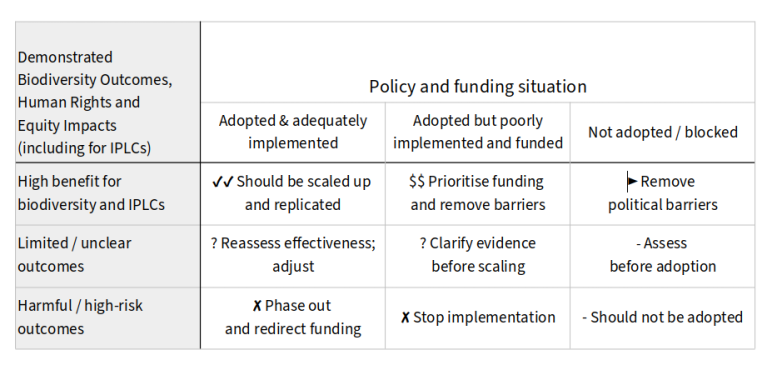
Beyond assessing ecological and social outcomes, the review must also examine whether policies address the structural drivers of biodiversity loss. Measures that leave extractive models and unsustainable production and consumption patterns untouched cannot deliver long-term change. These structural dimensions should be addressed in depth.
In which categories specific policies fall should be assessed on the basis of independent, transparent, and conflict-of-interest-free evidence rather than political preference. Whether undertaken within the next IPBES global assessment, through a dedicated IPBES study, or mandated to the Secretariat, such an evaluation must systematically examine if measures are effective for biodiversity, alongside human rights and equity dimensions, and include the perspectives of IPLCs. Only a robust and impartial assessment can provide the foundation for credible course correction. It is an essential and overdue component of results-based implementation under the GBF.
Not investing in a rigorous assessment of policy effectiveness, in the face of an acknowledged biodiversity funding gap, risks perpetuating the misallocation of already insufficient public resources, undermining the credibility of the GBF, and delaying the structural changes required to halt and reverse biodiversity loss.
Based on the outcomes, the Parties individually, and the CBD collectively need to decide what to enhance, what to redesign, and what to discontinue. Soon enough, discussions on how to continue the work after 2030 will be on the table. We ought to prepare the foundations now.