Tom Picken, Rainforest Action Network
Certain narratives have become so familiar in CBD negotiations that they almost fade into the background. "We need to mobilise more private finance." "Better disclosure will change markets." "Blended finance, biodiversity credits and debt swaps offer the way forward."
Some of these ideas may have a role to play. Others remain deeply contested. What they have in common is that they have become familiar ways of framing biodiversity finance debates. Like birdsong, once you learn to recognise them, you start hearing them everywhere.
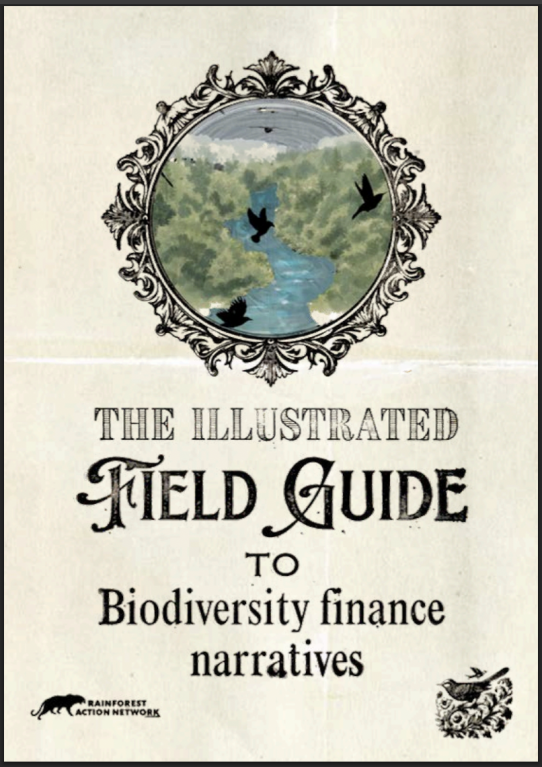
That's the idea behind Rainforest Action Network's new Illustrated Field Guide to Biodiversity Finance Narratives. Rather than arguing that any particular approach is simply right or wrong, it asks a different question: what questions does each narrative surface, and what questions might be obscured?
For many years, biodiversity finance discussions have centred on familiar questions. How do we close the finance gap? How do we mobilise more private investment? How do we create investable opportunities? How do we leverage public money to attract private capital? These are understandable questions, but they are not the only ones, nor necessarily the most important for achieving the KMGBF.
Reading across the documents before SBI-7, another set of questions come into focus. How do we reform harmful incentives? Are financial flows aligned with biodiversity outcomes? Is biodiversity integrated into economic, fiscal and financial decision-making? How do debt burdens, fiscal constraints and tax injustice affect implementation? Who receives finance directly? Are developed countries meeting their public finance commitments, and are those commitments clearly distinguished from finance mobilised from other sources?
The answers remain politically contested. But the prominence of these questions across the Global Review, Resource Mobilization and Mainstreaming Biodiversity agendas suggests something important: the biodiversity finance conversation is widening beyond finance mobilisation itself.
As private finance is increasingly presented as part of the solution to biodiversity loss, greater scrutiny of private finance inevitably follows. The more biodiversity finance becomes a conversation about private finance, the more it also becomes a conversation about how private finance is governed.
It is no longer enough simply to ask how much private finance can be mobilised. We also need to ask what private finance is already funding, whether it is aligned with biodiversity outcomes, and what rules, incentives and institutions shape those decisions. More fundamentally, the conversation shifts from asking how biodiversity affects financial markets towards asking how finance should better serve biodiversity and the people who protect it.
If implementation barriers are increasingly understood to be systemic, responses focused solely on mobilising additional finance, improving reporting or encouraging greater private-sector participation will not be sufficient. Policy coherence, reform of harmful incentives, financial regulation, debt relief, equitable tax systems, stronger public institutions, direct access for Indigenous Peoples and local communities, and fulfilment of developed-country public finance commitments all belong in the same implementation conversation.
The point is not that familiar biodiversity finance narratives should be discarded. Many contain part of the story. The risk is that, repeated often enough, they define the boundaries of the conversation, obscuring necessary critique of the wider financial and economic systems that continue to enable and drive biodiversity loss.
Perhaps that is the real value of a field guide. It does not tell you what to think. It simply helps you recognise familiar narratives, notice what has been left unsaid, and widen the conversation.
Because the future of biodiversity finance will be shaped not only by the text Parties negotiate this week and through to COP17, but by the questions they choose to ask.
Read the report at https://ran.org/biodiversity-finance-field-guide/